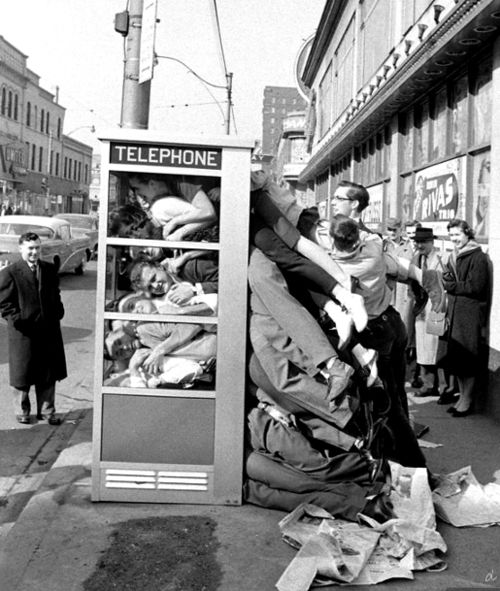
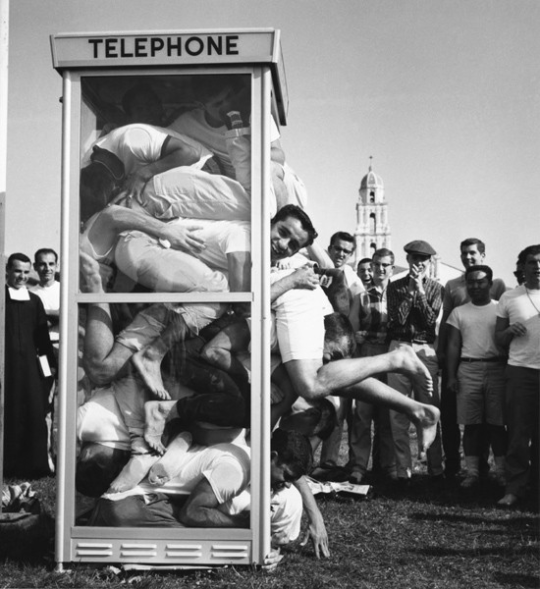
before the mannequin challenge, planking, or the Harlem Shake, the hot meme of 1959 involved teenagers cramming as many of themselves as possible into a phone booth
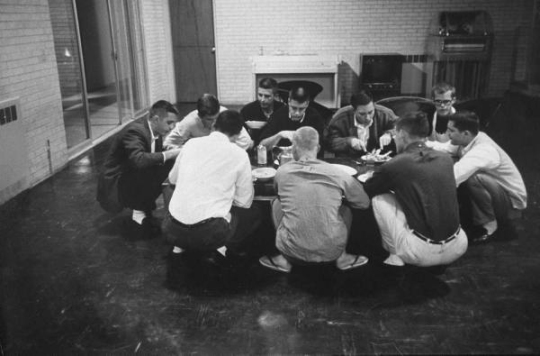
While phonebooth stuffing was arguably a pretty cool meme, it went out of style by the end of the year and was replaced by “hunkerin’”, which is as boring as it sounds and identical to the modern Slav Squat:
Hey, everybody! As many of you know, I track my writing in an Excel spreadsheet, and every year I try to share out a blank copy of it so that others can use it as well. If you’ve used a past version, grab the 2017 one for updated dates (I fixed it back to a non-leap year) and a fixed Pledges page! Go ahead now, you can download it from Drive here!
I’m including the instructions I posted last year, because I don’t want to rewrite everything.
So let’s talk a little about how I track. This might get long.
First tab is Wordcount. Here is where you will track each piece (by column) and each day (by row). For example, this is what my sheet looked like as of this morning:
The spreadsheet comes with the Dates and the Daily Total column already filled in. What you do is put the name of your first fic into D1, and the fest (if you’re tracking) into D2, and the starting word count (some of mine come out of the bunny folder with words already, like you can see that I started the year with coffee shop already begun) into D3. Then you can track the total words each day, and the total words for that day will show in the Daily Difference column (with your total for the year at the top). The Daily Total is just like Daily Difference total, only it includes the starting word count as well.
When you start a new day, just highlight the previous row from column C to the column after your last, and use the “drag down” function to copy the formulas and values down. You have to copy even the hidden columns (I hide a column when I’m done with that fic) or the totals won’t work.
That’s how I highlight, then I grab that little square on the bottom right to drag down one row.
And YES, you do see zero days. There are plenty of days when I don’t write at all. This happens. The important thing is not to let it get to you; the overall progress is what you need.
If you want to see a graphical representation of how you’ve done on a daily basis, you can go to the Daily Graph page. It’ll look kind of like this:
Do you see all those zero days? Don’t despair! It happens! Just keep writing on another day. Hells, sometimes I have almost zero weeks. I’ll post stats tomorrow for those of you who might be curious about the details.
There are also Monthly Totals and Monthly Graphs pages. The important thing to realize is that other than a very few fields, everything is calculated for you! You enter your word counts on the first page. You put a yearly goal on the Monthly Totals page, and that’s it (well, there are pledges, but we’ll get there).
On the Monthly Totals tab, you can put in your goal (I had a goal of 300k). The Words to Goal field will adjust throughout the year and you can see how close you are to your goal, or how much you have passed it by. The totals for each month fill in automagically once you keep your word count updated, and the average per day will adjust appropriately, too. And see, there’s a pretty graph by month, too.
The next two tabs might or might not be interesting to you. They involve some manual upkeep, and I did it mostly so I can compare stats from year to year. I carry my totals through each year so I can look at how my AO3 stats and how my monthly progress has changed. I’m actually kind of consistent in pattern, just not in production, by month per year (2013 was a weird year and I probably should be ignoring it).
Then there’s the newest tab, and my favorite tab: Pledges. I only did pledges for three months this year, but the new spreadsheet has space to pledge for each month (woohoo!).
On the pledge tab, fill in your word goal for that month (you can see I had a goal of 50000 for November). It will calculate what your expected daily word count should be, then will pull your actual word count per day from the primary spreadsheet and total everything up for you. It keeps track of where you are and where you should be and creates a neat graph. Yes, this is how I did that even while not doing NaNo. I like graphs. They’re pretty.
And that’s it for the spreadsheet! Yes, I’m aware that the thing makes me look a wee bit obsessive.
When I post my daily accountability, I use a goal percentage counter which anyone can access online. If you paste in the code http://picometer.writertopia.com/words=###&target=### into the URL for a photo post, with your current word count for the ### after words, and your goal for the month for the ### after target, you’ll get the cool little counter, complete with percentage. Quick and easy!
If anyone does use this, I’d love to know. And if you have any questions, please feel free to ask. I’ve found that knowing that I’m still being productive and heading toward my goal helps me feel better when I hit those days where I can’t find a word in my brain at all. I can look back and see the days when I had more words than expected and it makes me feel better about things. Because I know I’m getting somewhere.
I haven’t been updating the blog a lot and only recently started working on it again. This post sat at the bottom of my drafts. It’s been there for almost a year.
I wanted to start a new feature on the blog that would celebrate an artist and their work and I wanted to feature Tyrus Wong first; one of my favorite artists.
Earlier today he passed away at 106 years old. Tyrus Wong was a Chinese immigrant who spent the majority of his career being marginalized; his work often going unrecognized because of his race.
It was for his work on Disney’s Bambi, that Wong is perhaps most recognized for today, although, that took some time.
Inspired by the landscape paintings of the Song Dynasty, Wong created exquisite watercolor and pastel landscape paintings that would inspire the entire look of the film (see images above). Walt Disney loved his work so much that he was unofficially promoted as the films “inspirational sketch artist.”
Wong spent two years creating the illustrations that ultimately inspired the look and feel of thefilm Bambi. When animators and special effects artists had questions about color or lighting, they went to Wong. His work inspired everything from the tone of the film, to the special effects and the music.
Even though his work influenced the look and feel of the film, Wong’s named appeared at almost the bottom of Bambi’s credits as a background artist. Shortly after his work on Bambi ended, Wang, who had taken no part in them, was let go because of the animator’s strikes at Disney. Wang held no resentment toward the studio, believing that they had treated him good.
In 1942 he joined Warner Bros. where he worked as a storyboard artist, designer, and background artist until his retirement in 1968.
Since his retirement he’s done work primarily as a
painter and also worked as a muralist, ceramicist, lithographer, designer and later in life; a kite maker. In the 90′s he had a sort of resurgence as he became widely recognized for his work in fine art and painting.
Wong spent the majority of his career breaking racial barriers, not
letting himself be constrained by the lines set down by others and in 2001 he finally got the recognition he deserved for his work on Bambi; andwas honored as a Disney Legend.
1966-2016 Richard Paul Astley, 50, Husband of Lene Astley, passed away suddenly on December 29th, 2016 at Alliton Health Hospital in Lansdale, PA. Born on February 6, 1966 in Newton-le-Willows, UK,



 kototyph